
Logo of Robert Koch InstituteLogo of Robert Koch Institute
Publication Server of Robert Koch Instituteedoc
de|en
View Item 
  • edoc-Server Home
  • Artikel in Fachzeitschriften
  • Artikel in Fachzeitschriften
  • View Item
  • edoc-Server Home
  • Artikel in Fachzeitschriften
  • Artikel in Fachzeitschriften
  • View Item
JavaScript is disabled for your browser. Some features of this site may not work without it.
All of edoc-ServerCommunity & CollectionTitleAuthorSubjectThis CollectionTitleAuthorSubject
PublishLoginRegisterHelp
StatisticsView Usage Statistics
All of edoc-ServerCommunity & CollectionTitleAuthorSubjectThis CollectionTitleAuthorSubject
PublishLoginRegisterHelp
StatisticsView Usage Statistics
View Item 
  • edoc-Server Home
  • Artikel in Fachzeitschriften
  • Artikel in Fachzeitschriften
  • View Item
  • edoc-Server Home
  • Artikel in Fachzeitschriften
  • Artikel in Fachzeitschriften
  • View Item
2024-11-22Zeitschriftenartikel
Rapid Enzymatic Detection of Shiga-Toxin-Producing E. coli Using Fluorescence-Labeled Oligonucleotide Substrates
Ramming, Isabell
Lang, Christina
Hauf, Samuel
Krüger, Maren
Worbs, Sylvia
Peukert, Carsten
Fruth, Angelika
Dorner, Brigitte G.
Brönstrup, Mark
Flieger, Antje
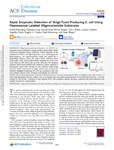
Shiga-toxin-producing Escherichia coli (STEC) are important human pathogens causing diarrhea, hemorrhagic colitis, and severe hemolytic uremic syndrome. Timely detection of the multifaceted STEC is of high importance but is challenging and labor-intensive. An easy-to-perform rapid test would be a tremendous advance. Here, the major STEC virulence factor Shiga toxins (Stx), RNA-N-glycosidases targeting the sarcin ricin loop (SRL) of 28S rRNA, was used for detection. We designed synthetic FRET-based ssDNA SRL substrates, which conferred a fluorescence signal after cleavage by Stx. Optimal results using bacterial culture supernatants or single colonies were achieved for substrate StxSense 4 following 30 to 60 min incubation. Stx1 and Stx2 subtypes, diverse STEC serotypes, and Shigella were detected. Within a proof-of-principle study, a total of 94 clinical strains were tested, comprising 65 STEC, 11 Shigella strains, and 18 strains of other enteropathogenic bacteria without Stx. In conclusion, the assay offers rapid and facile STEC detection based on a real-time readout for Stx activity. Therefore, it may improve STEC risk evaluation, therapy decisions, outbreak, and source detection and simplify research for antimicrobials.
Files in this item
Thumbnail
rapid-enzymatic-detection-of-shiga-toxin-producing-e-coli-using-fluorescence-labeled-oligonucleotide-substrates.pdf — Adobe PDF — 4.578 Mb
MD5: 07bd1cae8bbe8c6c38ddb6654c8e1b32
Cite
BibTeX
EndNote
RIS
(CC BY 3.0 DE) Namensnennung 3.0 Deutschland(CC BY 3.0 DE) Namensnennung 3.0 Deutschland
Details
Terms of Use Imprint Policy Data Privacy Statement Contact

The Robert Koch Institute is a Federal Institute

within the portfolio of the Federal Ministry of Health

© Robert Koch Institute

All rights reserved unless explicitly granted.