
Logo des Robert Koch-InstitutLogo des Robert Koch-Institut
Publikationsserver des Robert Koch-Institutsedoc
de|en
Publikation anzeigen 
  • edoc Startseite
  • Artikel in Fachzeitschriften
  • Artikel in Fachzeitschriften
  • Publikation anzeigen
  • edoc Startseite
  • Artikel in Fachzeitschriften
  • Artikel in Fachzeitschriften
  • Publikation anzeigen
JavaScript is disabled for your browser. Some features of this site may not work without it.
Gesamter edoc-ServerBereiche & SammlungenTitelAutorSchlagwortDiese SammlungTitelAutorSchlagwort
PublizierenEinloggenRegistrierenHilfe
StatistikNutzungsstatistik
Gesamter edoc-ServerBereiche & SammlungenTitelAutorSchlagwortDiese SammlungTitelAutorSchlagwort
PublizierenEinloggenRegistrierenHilfe
StatistikNutzungsstatistik
Publikation anzeigen 
  • edoc Startseite
  • Artikel in Fachzeitschriften
  • Artikel in Fachzeitschriften
  • Publikation anzeigen
  • edoc Startseite
  • Artikel in Fachzeitschriften
  • Artikel in Fachzeitschriften
  • Publikation anzeigen
2020-02-18Zeitschriftenartikel DOI: 10.1016/j.celrep.2020.01.070
The Human Cytomegalovirus pUL145 Isoforms Act as Viral DDB1-Cullin-Associated Factors to Instruct Host Protein Degradetion to Impede Innate Immunity
Le-Trilling, Vu Thuy Khanh
Becker, Tanja
Nachshon, Aharon
Stern-Ginossar, Noam
Schöler, Lara
Voigt, Sebastian
Hengel, Hartmut
Trilling, Mirko
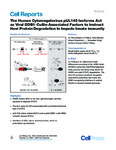
Human cytomegalovirus (HCMV) causes diseases in individuals with immature or compromised immunity. To evade immune control, HCMV evolved numerous antagonists targeting the interferon system at multiple levels. By comparative analysis of naturally arising variants of the most widely studied HCMV strain, AD169, and a panel of targeted mutants, we uncover the UL145 gene as indispensable for STAT2 downregulation. Ribosome profiling confirms the translation of the canonical pUL145 protein (pUL145-Long) and newly identifies a shorter isoform (pUL145-Short). Both isoforms recruit DDB1-containing ubiquitin ligases to induce proteasomal degradation of STAT2. An alanine-scanning mutagenesis discloses the DDB1 interaction motif of pUL145 that resembles the DDB1-binding interface of cellular substrate receptors of DDB1-containing ubiquitin ligases. Thus, pUL145 constitutes a viral DDB1-cullin-associated factor (vDCAF), which mimics cellular DCAFs to exploit the ubiquitin-proteasome system to impede antiviral immunity. Notably, the viral exploitation of the cullins can be targeted to restore the efficacy of the host immune response.
Dateien zu dieser Publikation
Thumbnail
1-s2.0-S2211124720300954-main.pdf — PDF — 4.382 Mb
MD5: eb057e648cb401e396258eda70231bb1
Zitieren
BibTeX
EndNote
RIS
(CC BY-NC-ND 3.0 DE) Namensnennung - Nicht-kommerziell - Keine Bearbeitung 3.0 Deutschland(CC BY-NC-ND 3.0 DE) Namensnennung - Nicht-kommerziell - Keine Bearbeitung 3.0 Deutschland(CC BY-NC-ND 3.0 DE) Namensnennung - Nicht-kommerziell - Keine Bearbeitung 3.0 Deutschland(CC BY-NC-ND 3.0 DE) Namensnennung - Nicht-kommerziell - Keine Bearbeitung 3.0 Deutschland
Zur Langanzeige
Nutzungsbedingungen Impressum Leitlinien Datenschutzerklärung Kontakt

Das Robert Koch-Institut ist ein Bundesinstitut im

Geschäftsbereich des Bundesministeriums für Gesundheit

© Robert Koch Institut

Alle Rechte vorbehalten, soweit nicht ausdrücklich anders vermerkt.

 
DOI
10.1016/j.celrep.2020.01.070
Permanent URL
https://doi.org/10.1016/j.celrep.2020.01.070
HTML
<a href="https://doi.org/10.1016/j.celrep.2020.01.070">https://doi.org/10.1016/j.celrep.2020.01.070</a>