The Human Cytomegalovirus pUL145 Isoforms Act as Viral DDB1-Cullin-Associated Factors to Instruct Host Protein Degradetion to Impede Innate Immunity
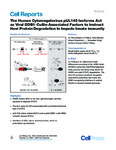
Human cytomegalovirus (HCMV) causes diseases in individuals with immature or compromised immunity. To evade immune control, HCMV evolved numerous antagonists targeting the interferon system at multiple levels. By comparative analysis of naturally arising variants of the most widely studied HCMV strain, AD169, and a panel of targeted mutants, we uncover the UL145 gene as indispensable for STAT2 downregulation. Ribosome profiling confirms the translation of the canonical pUL145 protein (pUL145-Long) and newly identifies a shorter isoform (pUL145-Short). Both isoforms recruit DDB1-containing ubiquitin ligases to induce proteasomal degradation of STAT2. An alanine-scanning mutagenesis discloses the DDB1 interaction motif of pUL145 that resembles the DDB1-binding interface of cellular substrate receptors of DDB1-containing ubiquitin ligases. Thus, pUL145 constitutes a viral DDB1-cullin-associated factor (vDCAF), which mimics cellular DCAFs to exploit the ubiquitin-proteasome system to impede antiviral immunity. Notably, the viral exploitation of the cullins can be targeted to restore the efficacy of the host immune response.
Dateien zu dieser Publikation