Transfer kinetics of fipronil into chicken (Gallus gallus domesticus) eggs
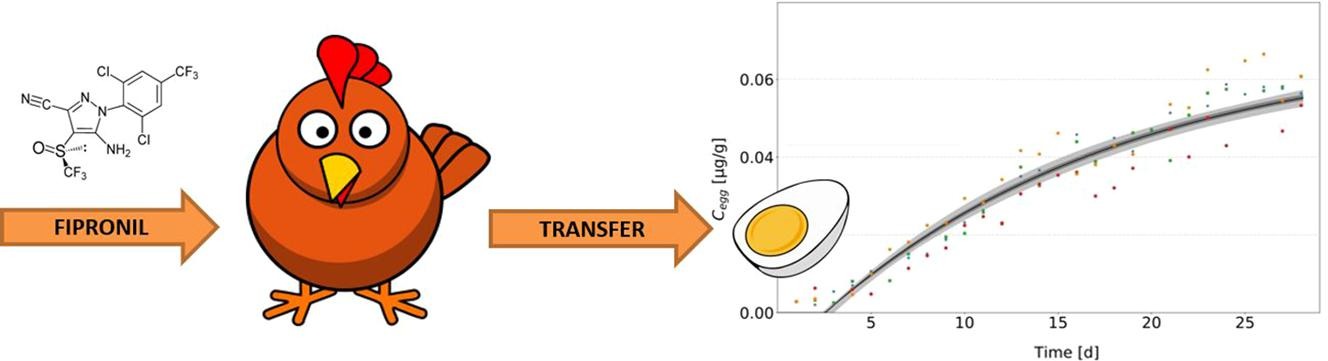
In 2017–2018, a fipronil contamination occurred in the European chicken egg supply chain due to its illegal use as insecticide to control red lice infestations. Fipronil has the potential to be transferred into eggs of laying hens, thereby entering the food chain. Here, we present a toxicokinetic model to predict the transfer of fipronil in laying hens as a tool for risk assessors and managers. Data from two studies documenting fipronil transfer to eggs were used as a basis to model its kinetic properties. We obtained estimates for fundamental kinetic parameters: the fraction of absorbed fipronil available for transfer 0.44 (CI95 0.41–0.50), the excretion into eggs half-life 11.3 d (CI95 9.9–13.8 d) and the delay of excretion after oral intake. We also calculated the transfer factor at steady state. The parametrized model was evaluated against an independent dataset, showing good correspondence upon visual inspection. The model can be of use in risk assessment and management of fipronil contamination events (repeated exposure) in the egg supply chain and as a starting point for more complex models, i.e. multiple compartments models, which could take in consideration the dynamics of egg-laying.
Dateien zu dieser Publikation