Logo of Robert Koch InstituteLogo of Robert Koch Institute
Publication Server of Robert Koch Instituteedoc
de|en
View Item 
  • edoc-Server Home
  • Artikel in Fachzeitschriften
  • Artikel in Fachzeitschriften
  • View Item
  • edoc-Server Home
  • Artikel in Fachzeitschriften
  • Artikel in Fachzeitschriften
  • View Item
JavaScript is disabled for your browser. Some features of this site may not work without it.
All of edoc-ServerCommunity & CollectionTitleAuthorSubjectThis CollectionTitleAuthorSubject
PublishLoginRegisterHelp
StatisticsView Usage Statistics
All of edoc-ServerCommunity & CollectionTitleAuthorSubjectThis CollectionTitleAuthorSubject
PublishLoginRegisterHelp
StatisticsView Usage Statistics
View Item 
  • edoc-Server Home
  • Artikel in Fachzeitschriften
  • Artikel in Fachzeitschriften
  • View Item
  • edoc-Server Home
  • Artikel in Fachzeitschriften
  • Artikel in Fachzeitschriften
  • View Item
2020-07-29Zeitschriftenartikel DOI: 10.1016/j.comtox.2020.100131
Transfer kinetics of fipronil into chicken (Gallus gallus domesticus) eggs
Gerletti, Pietro
von Kleist, Max
Mielke, Hans
Kuhl, Thomas
Pieper, Robert
Lahrssen-Wiederholt, Monika
Numata, Jorge
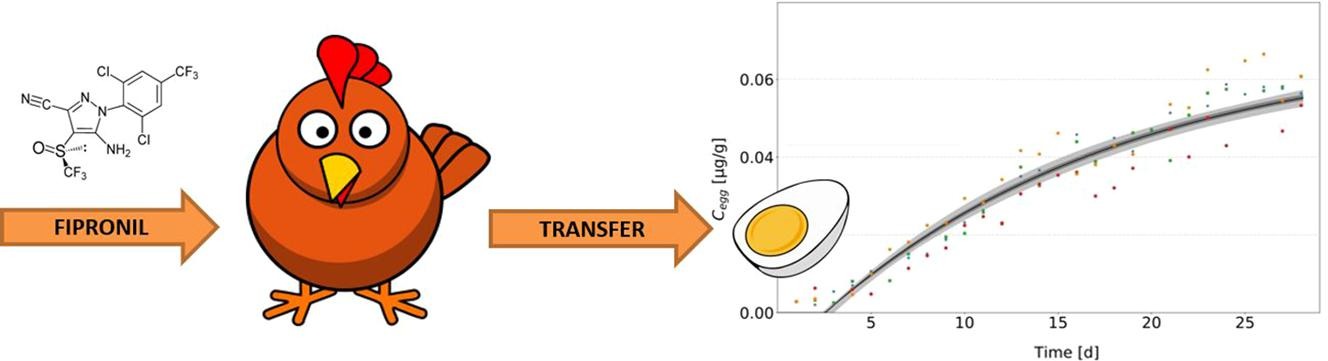
In 2017–2018, a fipronil contamination occurred in the European chicken egg supply chain due to its illegal use as insecticide to control red lice infestations. Fipronil has the potential to be transferred into eggs of laying hens, thereby entering the food chain. Here, we present a toxicokinetic model to predict the transfer of fipronil in laying hens as a tool for risk assessors and managers. Data from two studies documenting fipronil transfer to eggs were used as a basis to model its kinetic properties. We obtained estimates for fundamental kinetic parameters: the fraction of absorbed fipronil available for transfer 0.44 (CI95 0.41–0.50), the excretion into eggs half-life 11.3 d (CI95 9.9–13.8 d) and the delay of excretion after oral intake. We also calculated the transfer factor at steady state. The parametrized model was evaluated against an independent dataset, showing good correspondence upon visual inspection. The model can be of use in risk assessment and management of fipronil contamination events (repeated exposure) in the egg supply chain and as a starting point for more complex models, i.e. multiple compartments models, which could take in consideration the dynamics of egg-laying.
Files in this item
Thumbnail
1-s2.0-S2468111320300414-main.pdf — Adobe PDF — 1.241 Mb
MD5: 418e9dd5764439f2228dea8543d507c6
1-s2.0-S2468111320300414-ga1_lrg.jpg — JPEG image — 46.78 Kb
graphical abstract
MD5: 40227d872fb7885e3981da12f091ff10
Cite
BibTeX
EndNote
RIS
(CC BY 3.0 DE) Namensnennung 3.0 Deutschland(CC BY 3.0 DE) Namensnennung 3.0 Deutschland
Details
Terms of Use Imprint Policy Data Privacy Statement Contact

The Robert Koch Institute is a Federal Institute

within the portfolio of the Federal Ministry of Health

© Robert Koch Institute

All rights reserved unless explicitly granted.

 
DOI
10.1016/j.comtox.2020.100131
Permanent URL
https://doi.org/10.1016/j.comtox.2020.100131
HTML
<a href="https://doi.org/10.1016/j.comtox.2020.100131">https://doi.org/10.1016/j.comtox.2020.100131</a>